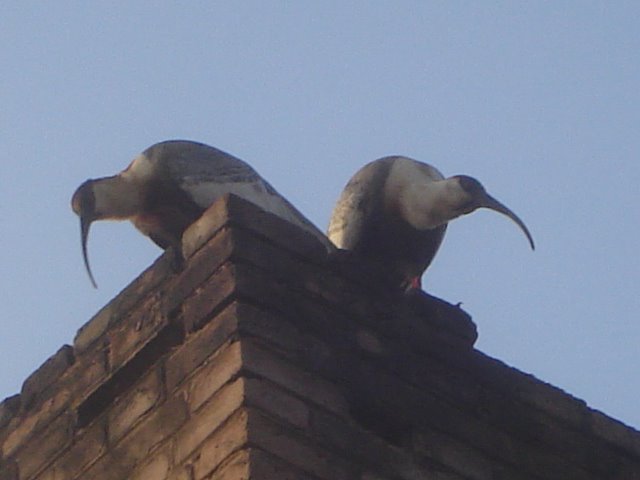
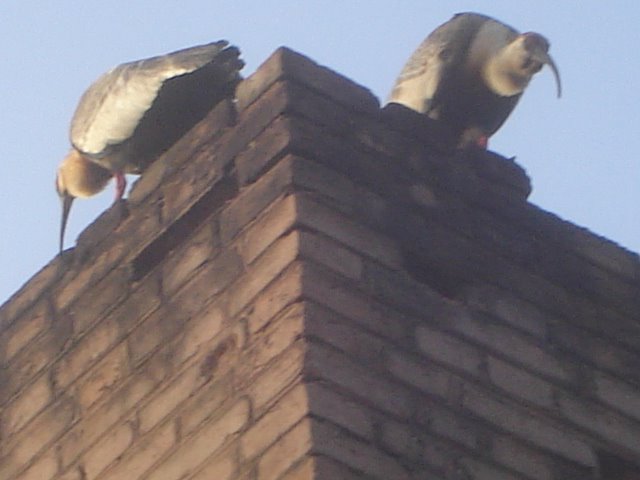
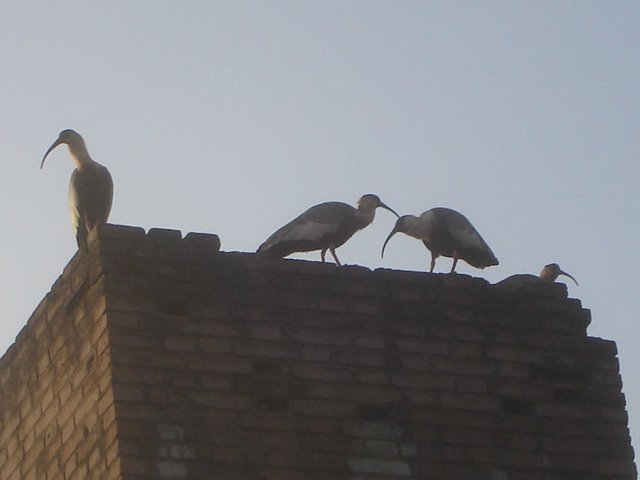
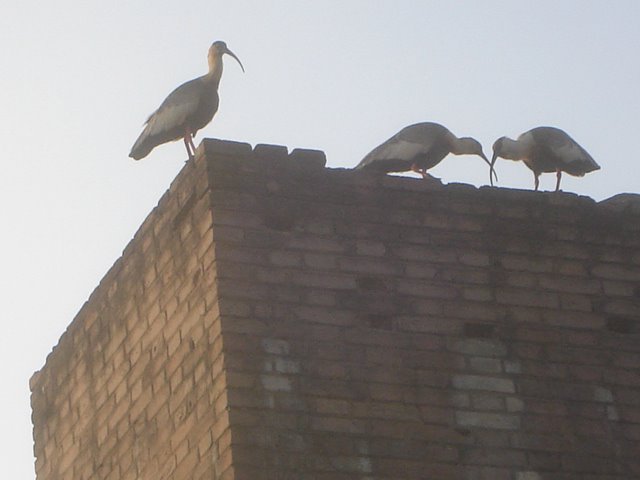
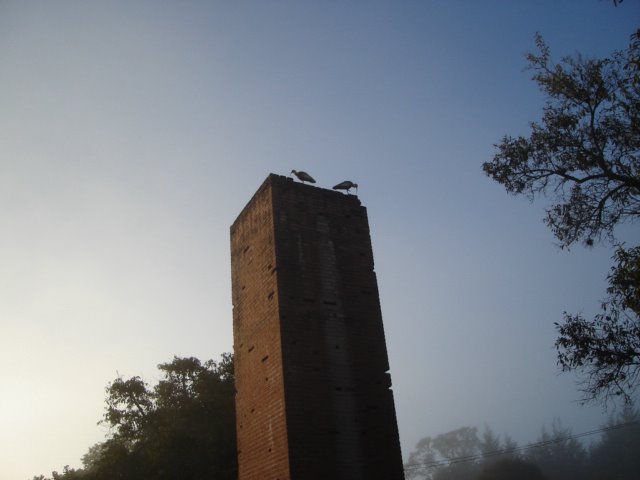
There are a couple of owls living in my yard and many others in my neighborhood. It’s so beautiful to see them all the time, here and there, flying off overhead, every day, around all the year. One evening I arrived to find the owl actively hunting and I saw the owl kills and eats a big mouse. I stayed just still to watching it. With smaller prey owls simply swallow the animal whole. But with larger prey, an owl must tear off bits of meat to swallow. It’s very common see the owl floating silently upward into a tree. They drop from a high perch and fly low to the ground. It sometimes calls in the daytime and if disturbed will fly easily from one grove of trees to another. My husband took these pictures near our house. A couple of beautiful owls just stared at him straight from the top of the kiosk.
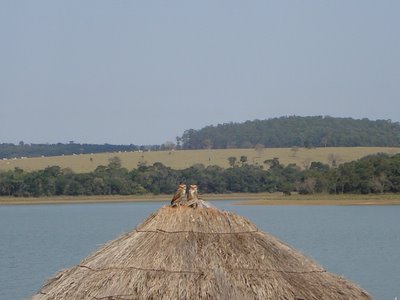 I summarize some interesting information about Owls. "The Owl is any of some 200+ species of solitary, mainly nocturnal birds of prey in the order Strigiformes. Owls mostly hunt small mammals, insects, and other birds, though a few species specialize in hunting fish. They are found on all the Earth's lands except for Antarctica, most of Greenland, and some remote islands."
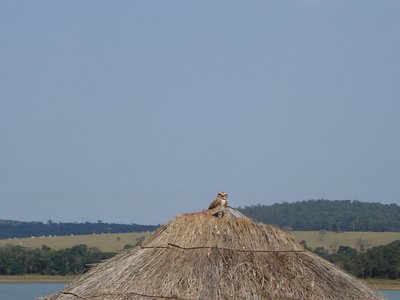 Owls are far-sighted, and are unable to clearly see anything within a few inches of their eyes. Their far vision, particularly in low light, is incredibly good.Many owls can also hunt by sound in total darkness. Different species of owls make different sounds, and a variety of other barking calls and screams. One of which is the recognizable "hoo-hoo” Click on this site to hear their
  "hoo-hoo".
"The Burrowing Owl is an owl of dry, open habitats such as “cerrado” and savannah while it is often found in cities, golf courses and other similar areas. It nests in the ground usually in a burrow excavated by another animal such as a skunk or armadillo."
"Most owls are nocturnal, but several, including the pygmy owls (Glaucidium), are crepuscular, or twilight active, hunting mainly at dawn and dusk. A few owls, such as the Burrowing Owl (Speotyto cunicularia) and the Short-eared Owl (Asio flammeus), are also active during the day.
"In the Western world, owls are traditionally associated with wisdom and knowledge and with the Greek goddess Athena. That's because Athena was a bird goddess and assumed often the form of an owl. Athena was not only the goddess of wisdom, but was also the goddess of arts and skills. With this association, owls became also the symbol of teaching and of institutions of learning, being present in the crest of arms of many universities.
The Ancient Egyptians made a representation of an owl into their hieroglyph for 'm', although they would often draw this hieroglyph with its legs broken to keep the bird of prey from coming to life and attacking.
In Japanese culture, the bird is a symbol of death and seeing one is considered a bad omen. The same is true in Italian and Romanian culture, where the mournful call of an owl predicts the death of somebody living in the neighborhood.
The Romans also considered owls to be funerary birds, for their nocturnal activity and having their nests in inaccessible places, therefore, seeing an owl at daytime was considered a bad omen.
Taboo surrounds owls in the culture of the Native American Hopi nation, they are regarded as a dirty and ominous creature."
Next post I will introduce another wild bird seen at Enseada Azul: the Hawks.
Photos by Carlos Alckmin Mascaro


 These two photos of a Gavião, Roadside Hawk, (Buteo magnirostris, aka Rupornis magnirostris) was shoted by my husband. The order Falconiformes is a group of about 290 species of birds that include the diurnal birds of prey. Raptor classification is fraught with difficulty and the order is treated in several different ways.