My daughter Sofia (at right) and her friend Thais Guimarães at Café Montanha, Largo da Portagem, in Coimbra. Minha filha Sofia (à direita) e sua amiga Thais Guimarães no Café Montanha, no Largo da Portagem, em Coimbra.
Coimbra is a city in the municipality of Coimbra in Portugal. The historic city of Coimbra is located in central Portugal and according 2001 Census, the city proper had a population of 101,069. The city of Coimbra is one of the most important urban centres in Portugal and the principal centre in the Centro region, the District of Coimbra and the Baixo Mondego subregion. Coimbra is famous for its monuments, churches, libraries, museums, parks, but above all for its intense cultural life, centered on the University of Coimbra, one of the oldest universities in Europe.
Coimbra é uma cidade portuguesa, capital do Distrito de Coimbra, a maior cidade da região Centro de Portugal e situada na sub-região do Baixo Mondego. Segundo o Censo de 2001, a cidade contava com cerca de 101 069 habitantes. Coimbra é famosa por seus monumentos, igrejas, livrarias, museus, parques e sua intensa vida cultural, centrada na Universidade de Coimbra, uma das mais antigas universidades da Europa.
 |
|
Largo da Portagem is a square that faces the Santa Clara Bridge, at the margin of Mondego River. Portagem means the entrance or gate to the city. There are many shops, coffee shop and beautiful Baroque buildings around this square. You will see a statue in honour of Joaquim António de Aguiar - an outstanding Portuguese politician - that stands in the middle of the square.
O Largo da Portagem é uma praça situada junto à Ponte de Santa Clara e à margem do rio Mondego. O nome da praça deve-se ao fato de antigamente se cobrarem impostos sobre as mercadorias que chegavam à cidade vindas do sul. Nesta praça há muitas lojas, cafés e bonitos prédios no estilo barroco. Você pode ver a estátua de Joaquim Antônio de Aguiar, um iminente político português, no centro da praça.
Portagem Square and Street Ferreira Borges. Largo da Portagem e Rua Ferreira Borges.
Rua (Street) Ferreira Borges.
 |
Rua (Street) Ferreira Borges.
|
 |
Rua (Street) Ferreira Borges.
|
 |
Rua (Street) Ferreira Borges.
|
Barbacã Arch or Gate (also known as the small Almedina Arch).The Arche are believed to have been erected sometime in the 11th century and are the only remaining survivors of the famed defensive wall and gates. Barbacã Gate, is one of the most visited tourist attractions in Coimbra.
O Arco ou Porta de Barbacã (também conhecida como Pequeno Arco de Almedina) foi construído no século XI para reforçar a defesa da cidade. O Arco de Barbacã é um dos mais visitados pontos turísticos de Coimbra.
8th May Square. Praça 8 de Maio.
8th May Square. Praça 8 de Maio.
Church of the Monastery of Santa Cruz at 8th May Square. Igreja do Mosteiro de Santa Cruz, na Praça 8 de Maio.
The Manueline façade ( Portuguese late Gothic) of the Santa Cruz Monastery, at 8th May Square, where is located the tomb of Afonso Henriques, the first King of Portugal.
Fachada em estilo Manuelino (Gótico Português tardio) da Igreja do Mosteiro de Santa Cruz, na Praça 8 de Maio, onde está situado o túmulo de Afonso Henriques, o primeiro Rei de Portugal.
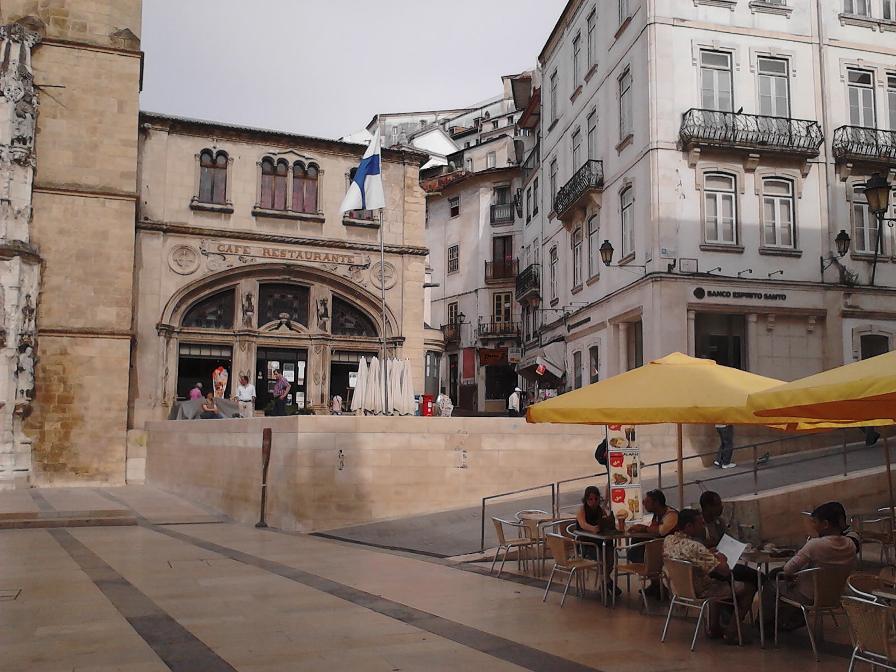
Coffee and Restaurant Santa Cruz. Café e Restaurante Santa Cruz.
 |
Manga Garden founded in the 16th century, it was originally part of the Monastery of Santa Cruz, in the low city (Cidade Baixa). This original composition of elements was created by Renaissance artist Jean de Rouen for King Joao III. It gets its name from the fact that the king sketched the design of the garden on his sleeve ("manga" in Portuguese). The domed fountain in the centre is buttressed by four small circular chapels. O Jardim da Manga, também conhecido como Claustro da Manga, localiza-se atrás do Mosteiro de Santa Cruz, na Cidade Baixa. É uma das primeiras obras arquitetônicas inteiramente renascentistas feitas em Portugal, por Jean de Rouen, para o Rei João III. Acerca de seu nome, diz a tradição que certo dia em que o Rei João III de Portugal visitava o mosteiro, esboçou na manga do seu gibão um claustro e jardim circundante, que mandou depois executar.
|
Coimbra's City Hall at 8th May Square. Câmara Municipal de Coimbra, na Praça 8 de Maio.
A panoramic view over the low city (Cidade Baixa) and River Mondego, from the Coimbra University. As early as the Middle Ages, Coimbra was divided into an upper city (Cidade Alta), where the aristocracy and the clergy lived, and the low city (Cidade Baixa) by the Mondego River, where most commercial activities took place. Panorâmica da Cidade Baixa e do Rio Mondego, vista da Universidade de Coimbra. No começo da Idade Média Coimbra era dividida em Cidade Alta, onde a aristocracia e o clero viviam e a Cidade Baixa margeando o Rio Mondego, onde eram exercidas a maioria das atividades comerciais.
Photos taken by Sofia de Amorim Mascaro